Point of View in Literature: Types, Examples, and How to Choose
 By Shihab Mia June 30, 2026 10 min read
Quick answer
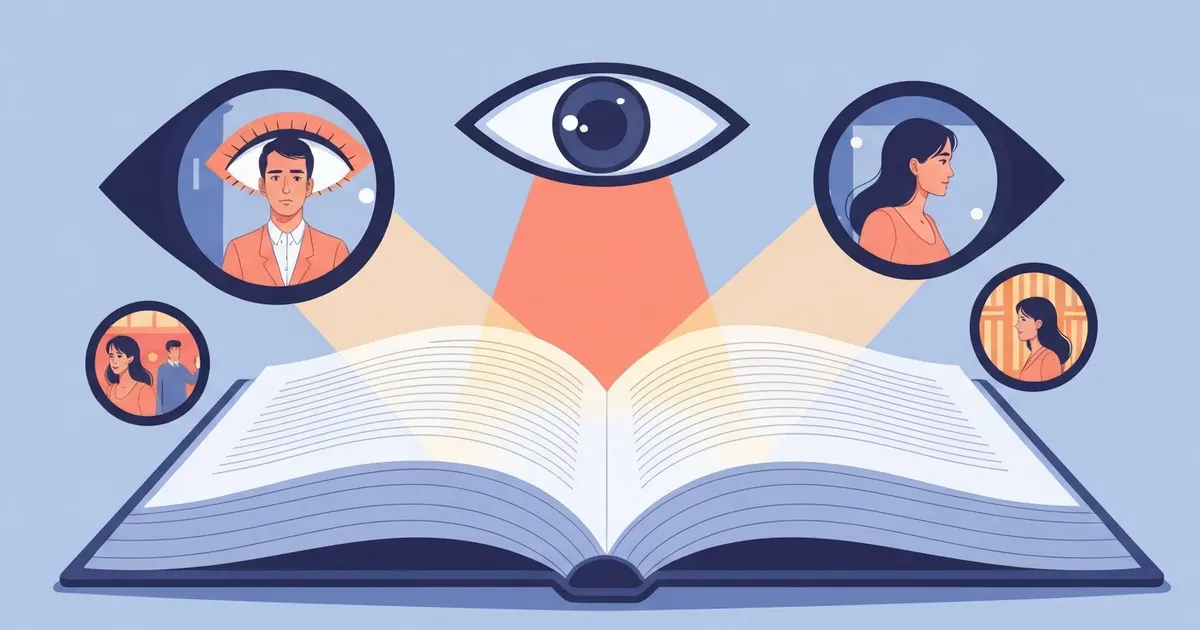
Point of view (POV) is the perspective from which a story is told. The main types are first person (the narrator is a character using I or we), second person (the narrator speaks to you), and third person, which splits into limited (one character's thoughts, using he or she), omniscient (an all knowing narrator who sees every character's mind), and objective (an outside narrator who reports only what can be seen and heard). Each choice changes how intimate the story feels and how much the reader is allowed to know.
Two writers can take the exact same events, the same characters, and the same ending, and tell utterly different stories simply by changing who is telling it. That choice is point of view, and it is one of the first and most important decisions a writer makes. It controls whose head you sit inside, what you are allowed to know, and how close you feel to the action.
This guide explains what point of view is, walks through every main type with clear examples, compares them side by side, and shows how to pick the right one for your own writing. By the end you will be able to name the POV of anything you read and choose it deliberately when you write.
What is point of view in literature?
Point of view is the perspective from which a story is told. It answers a simple question: who is narrating, and how much do they know? The narrator is the voice telling the story, and the point of view is the angle that voice takes on the events. Change the narrator and you change what the reader sees, hears, and feels.
Two things flow directly from point of view. The first is intimacy, or how close the reader feels to the characters. The first person voice of someone telling their own story feels far more personal than a distant outside narrator. The second is knowledge, or how much the reader is allowed to know. An all knowing narrator can reveal every character's secrets, while a single character narrator can only report what that one person sees and guesses.
Point of view is a core building block of storytelling, sitting alongside tools like foreshadowing and dramatic irony, both of which depend heavily on what a narrator does and does not reveal. Getting POV right is what makes those other devices possible.
The main types of point of view
There are three broad families of point of view, with third person splitting into three distinct modes. The table below lays them out at a glance, and the sections after it explain each one with examples you will recognize.
The main points of view compared
| Point of view | Pronouns | What the reader knows | How it feels |
|---|---|---|---|
| First person | I, we | Only what the narrator sees, thinks, and feels | Very intimate, possibly biased |
| Second person | You | What the implied you experiences | Direct, immersive, unusual |
| Third person limited | He, she, they | One character's thoughts and senses | Close but slightly outside |
| Third person omniscient | He, she, they | Every character's thoughts, plus the big picture | Wide, godlike, all knowing |
| Third person objective | He, she, they | Only what can be seen and heard, no thoughts | Detached, cinematic, neutral |
First person point of view (I, we)
In first person point of view, the narrator is a character inside the story telling it in their own words, using I or we. The reader sees only what this narrator sees and knows only what they know, which makes the voice deeply personal but also limited and sometimes unreliable. A famous example is The Adventures of Huckleberry Finn by Mark Twain, narrated by Huck himself, where the whole world reaches us through his voice and judgment. First person is the natural home of the unreliable narrator, because we cannot step outside that single mind to check the facts.
Second person point of view (you)
Second person point of view casts the reader as a character by addressing them directly as you, as in "You walk into the room and the door locks behind you." It is the rarest of the main modes in fiction because it is hard to sustain, but it creates a striking, immersive effect that pulls the reader straight into the action. You meet it most often in choose your own adventure books, in some experimental novels such as Jay McInerney's Bright Lights, Big City, and in instructions, recipes, and persuasive marketing copy.
Third person limited point of view
Third person limited uses outside pronouns like he, she, and they, but stays locked to one character's thoughts and senses at a time. The narrator is not a character in the story, yet we only experience the world through a single chosen mind, so we share that character's knowledge and blind spots. Much of the Harry Potter series works this way: the narration is third person, but we almost always stay tied to what Harry himself perceives. It blends the closeness of first person with the flexibility of an outside voice.
Third person omniscient point of view
Third person omniscient gives the narrator a godlike view: an all knowing voice that can enter any character's mind, move freely across time and place, and tell the reader things no single character could know. The narrator may even comment directly on events. Leo Tolstoy's War and Peace is a classic example, sweeping between many characters and their inner lives. This mode offers the widest scope, though it can feel less intimate because the reader is never anchored to just one perspective.
Third person objective point of view
Third person objective is the most detached mode. The narrator reports only what can be observed from the outside, the actions and the dialogue, and never enters anyone's thoughts. The effect is cinematic and neutral, like a camera recording a scene without commentary. Ernest Hemingway's short story Hills Like White Elephants is often cited as a model, told almost entirely through what the characters say and do, leaving the reader to infer their feelings. This restraint forces the reader to interpret rather than be told.
A quick way to feel the difference is to watch one moment rendered five ways. First person: "I gripped the letter and knew it was over." Second person: "You grip the letter and know it is over." Third person limited: "She gripped the letter and knew it was over." Third person omniscient: "She gripped the letter and knew it was over, though the man who wrote it had already changed his mind." Third person objective: "She gripped the letter, read it once, and set it face down on the table." Same event, five very different amounts of access.
Less common points of view worth knowing
Beyond the five core modes, a handful of variations show up often enough that it helps to name them. Each is really a flavor of first or third person rather than a separate family, but each creates a distinct effect.
- First person peripheral. The narrator is a character in the story but not its hero; they narrate someone else's story from the sidelines. Nick Carraway telling Gatsby's story in The Great Gatsby, and Dr Watson narrating Sherlock Holmes, are the classic cases.
- First person plural. A collective we narrates, speaking for a group rather than one person. Jeffrey Eugenides uses it in The Virgin Suicides, where the neighborhood boys narrate as a single voice.
- Epistolary. The story is assembled from documents such as letters, diary entries, emails, or news clippings, each usually in first person. Bram Stoker's Dracula and Mary Shelley's Frankenstein build their tension this way.
- Alternating or multiple POV. Many modern novels rotate between several third person limited viewpoints, one per chapter, giving the reach of omniscience while keeping each scene anchored to a single mind.
First person vs third person: how to choose
Choose first person when you want raw intimacy and a strong, distinctive voice, and choose third person when you want flexibility and a wider view of the story world. First person puts the reader directly inside one character's skin, which is powerful for personal, emotional, or mystery driven stories where a limited and possibly biased viewpoint adds tension. Third person, especially limited, gives you the same closeness with the freedom to pull back, switch characters between chapters, and describe things the protagonist cannot see.
First person vs third person limited at a glance
| Feature | First person | Third person limited |
|---|---|---|
| Pronoun | I, we | He, she, they |
| Intimacy | Highest, inside one mind | High, close but a step outside |
| Voice | Strong, personal, can be unreliable | Flexible, can shift register |
| Switching characters | Hard, one narrator per section | Easier between chapters or scenes |
| Best for | Memoir style, voice driven, mystery | Most novels, balanced control |
There is no single best point of view, only the one that fits your story. Consider how much you want the reader to know, how close you want them to feel, and how many characters you need to follow. Many beginning writers default to third person limited because it is forgiving and widely used, but a strong first person voice can carry a story all on its own.
How do you identify the point of view in a text?
To identify the point of view, look first at the pronouns the narrator uses and then at how much the narrator knows. The pronouns tell you the broad family, and the depth of knowledge tells you which third person mode you are dealing with. The quick checks below work on almost any passage.
- Find the pronouns. If the narrator says I or we, it is first person. If it speaks to you, it is second person. If it uses he, she, or they for everyone, it is third person.
- For third person, test the knowledge. Ask whether the narrator enters anyone's thoughts. No thoughts at all means objective. One character's thoughts only means limited. Every character's thoughts means omniscient.
- Watch for a single anchor character. If the story sticks to one mind scene after scene, that is third person limited even when it covers many chapters.
- Notice narrator commentary. A voice that explains, judges, or jumps across time and place beyond any character's knowledge is a strong sign of omniscience.
One sentence is often enough. "She had no idea what he was thinking" is third person limited or objective, because the narrator is held to one viewpoint. "She had no idea what he was thinking, but he was already planning his escape" is omniscient, because the narrator just stepped into a second mind.
Why point of view matters so much
Point of view is not a technical footnote. It quietly shapes almost everything about how a story lands. Here is the real work it does.
- It controls knowledge. POV decides what the reader is allowed to know and when, which is the engine behind suspense, surprise, and mystery.
- It sets distance. A first person voice feels close and personal, while an objective narrator keeps the reader at arm's length, and that distance shapes emotion.
- It enables irony. When the reader knows something a character does not, you get dramatic irony, a powerful effect that depends entirely on whose viewpoint we share.
- It builds voice. The narrator's personality, vocabulary, and biases color every sentence, giving the whole work its distinctive flavor.
- It can mislead on purpose. An unreliable narrator, only possible in certain points of view, lets a writer hide the truth in plain sight.
Common mistakes to avoid
- Head hopping. Slipping from one character's thoughts into another's within a single scene confuses readers. In third person limited, stay in one mind per scene.
- Breaking the rules of your POV. In first person, the narrator cannot report what happens in a room they were never in. In objective POV, the narrator cannot suddenly reveal a thought.
- Confusing point of view with tense. Point of view is about who narrates; tense is about when the action happens. A first person story can be past or present tense.
- Choosing omniscient by accident. Drifting into every character's head when you meant to write limited usually signals a lack of control, not a deliberate wide view.
- Forgetting the narrator's limits. The strongest stories respect what the narrator can and cannot know, and use those limits to create tension.
Good to know
Point of view and verb tense are separate choices. POV asks who is telling the story (first, second, or third person), while tense asks when it is happening (past or present). You can mix them freely: a story can be first person present ("I walk in"), first person past ("I walked in"), third person past, and so on. Deciding both early keeps your narration consistent.
Point of view also interacts with how you build characters and structure. A narrator's biases are part of their character traits, and the viewpoint you choose decides which character's eyes the reader watches the plot unfold through. Get the perspective right and every other storytelling tool, from foreshadowing to irony, has something solid to stand on.
In the end, point of view is the lens you hand the reader. First person hands them one character's eyes and voice, second person makes them the character, and the three kinds of third person let you choose between deep focus on one mind, a sweeping all knowing view, or a cool outside camera. Learn how each one shapes intimacy and knowledge, then pick the lens that lets your story do exactly what you want it to do.
Frequently asked questions
What is point of view in literature in simple terms?
Point of view is the perspective a story is told from, meaning who is narrating and how much they know. It controls whose eyes the reader sees through. The main types are first person, second person, and third person, with third person splitting into limited, omniscient, and objective.
What are the main types of point of view?
The main types are first person (the narrator is a character using I or we), second person (the narrator addresses you), and third person. Third person divides into limited (one character's thoughts), omniscient (an all knowing narrator who sees every mind), and objective (an outside narrator who reports only actions and dialogue).
What is the difference between third person limited and omniscient?
Third person limited stays inside one character's mind, so the reader knows only what that character knows. Third person omniscient is all knowing and can enter any character's thoughts and reveal facts no single character could know. Limited feels intimate; omniscient feels wide and godlike.
What is an example of first person point of view?
A first person narrator tells the story using I or we, sharing only what they personally see and feel. The Adventures of Huckleberry Finn by Mark Twain is a classic example, narrated by Huck himself. First person is also the natural home of the unreliable narrator, since the reader cannot check the facts independently.
Is second person point of view common in fiction?
No, second person is the rarest of the main modes because it is hard to sustain across a long work. It addresses the reader directly as you, creating a striking, immersive effect. It appears most often in choose your own adventure books, some experimental novels, and in recipes, instructions, and marketing copy.
Is point of view the same as verb tense?
No. Point of view is about who narrates the story, while verb tense is about when the action happens. A first person story can be written in past tense (I walked) or present tense (I walk). The two are independent choices, and you decide both when you set up your narration.
What is the most common point of view in fiction?
Third person limited is the most common choice in modern fiction because it balances intimacy with flexibility: the reader stays close to one character's mind yet the narrator can shift focus between chapters. First person is the next most common, prized for its strong, personal voice. Second person remains rare.
Can a novel use more than one point of view?
Yes. Many novels alternate points of view, often assigning one character's third person limited perspective per chapter, which gives wide coverage while keeping each scene anchored to a single mind. Some books even mix first and third person. The key is to switch clearly, usually at chapter or scene breaks, so readers never lose track of whose eyes they are seeing through.