Symbolism in Literature: Definition, Types, and Examples
 By Shihab Mia June 28, 2026 9 min read
Quick answer
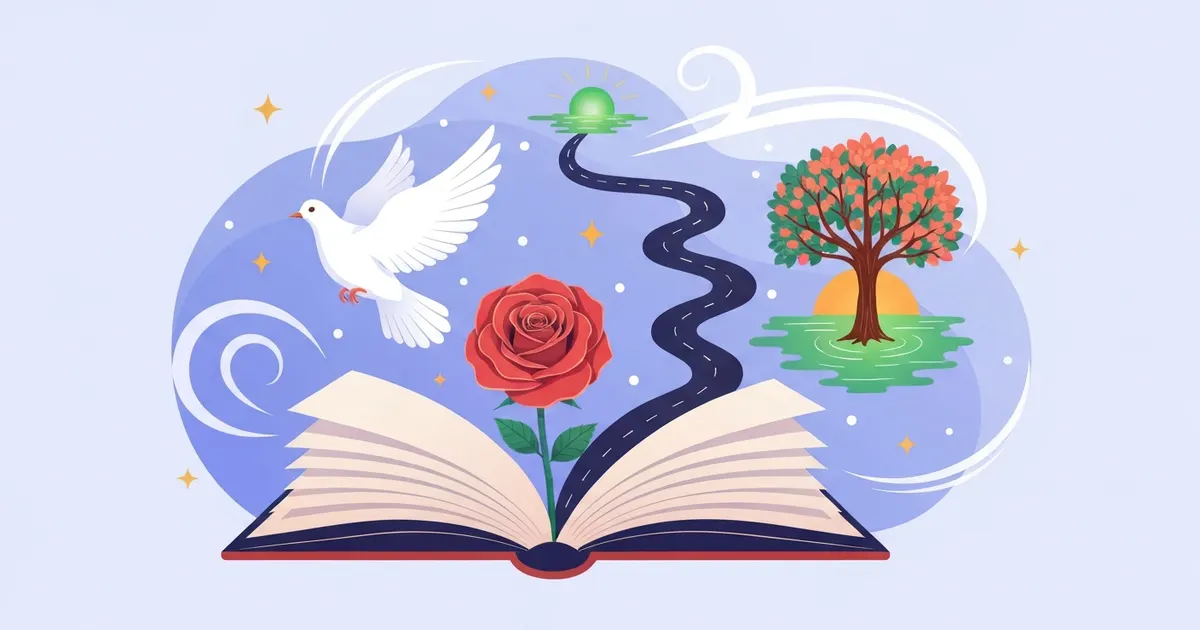
Symbolism in literature is the use of an object, person, color, or action to represent a deeper idea or meaning beyond its literal sense. The symbol is the concrete thing on the page, while what it stands for is the abstract idea. A dove can stand for peace, a road for a life choice, the color red for love or danger, and the changing seasons for the stages of life.
When a single white dove rises over a battlefield in a story, it is doing more than flying. It carries the idea of peace into a scene of conflict without the writer spelling it out, which is symbolism at work. This guide covers the main types with well known examples, how symbolism differs from metaphor, allegory, and motif, and how to spot it when you read.
What is symbolism in literature?
Symbolism is the use of an object, person, color, or action to represent a deeper idea or meaning beyond its literal sense. There are always two layers at work. The first is the symbol, the concrete thing you can see or touch in the text. The second is what that thing stands for, an abstract idea such as freedom, death, hope, or corruption. A chain is just metal links, but in a story about slavery it can stand for bondage and the loss of freedom.
What separates symbolism from ordinary description is intent and recurrence. A symbol usually appears more than once and gathers meaning as the work goes on. The first time you see it, it may look like a plain detail. By the third or fourth time, the reader senses it is pointing at something bigger. This slow build is why symbolism feels earned rather than stated, and why it rewards a second reading.
Symbolism is one branch of the wider family of figurative language, which also includes simile, metaphor, and personification. If you want the full map of devices writers use to layer meaning, our guide to literary devices sets symbolism alongside its neighbors. For a general dictionary definition of the term itself, see Britannica's entry on symbolism.
What are the main types of symbolism?
The main types of symbolism are object, color, action, nature, animal, and setting symbols, grouped by what carries the meaning. The table below lists each type, and the sections after it explain the four most common ones with examples you will recognize.
Common types of symbolism with everyday examples
| Type | What carries the meaning | Common example |
|---|---|---|
| Object | A physical thing | A dove standing for peace |
| Color | A hue or shade | Red standing for love or danger |
| Action | Something a character does | A road or journey standing for a life choice |
| Nature | A natural force or cycle | Seasons standing for the stages of life |
| Animal | A creature | A snake standing for temptation or evil |
| Setting | A place | A locked garden standing for innocence kept apart |
Object symbols
An object symbol is a physical thing that points to an idea. The white whale in Herman Melville's Moby-Dick is read by many as a symbol of an unknowable, all consuming obsession. The green light at the end of the dock in F. Scott Fitzgerald's The Great Gatsby is widely taught as a symbol of Gatsby's longing and the distant American dream. The object stays solid and real while the meaning hovers behind it.
Color symbols
Colors are some of the oldest symbols we have. Red commonly stands for love, passion, anger, or danger depending on the scene. White often suggests purity or innocence, while black can signal death or the unknown. In Nathaniel Hawthorne's The Scarlet Letter, the red letter A worn by Hester Prynne is a famous color symbol that shifts in meaning across the novel, from shame toward strength.
Action and journey symbols
An action can carry symbolic weight too. A road or journey is one of the most common, standing for a life choice or the path a person takes. Robert Frost's poem The Road Not Taken uses two diverging paths in a wood as a widely discussed symbol of a decision, though the Poetry Foundation notes the poem is more often quoted than carefully read, and its tone is more ambiguous than the popular inspirational reading suggests. Crossing a river, climbing a mountain, or opening a door can all signal change, struggle, or a new beginning.
Nature and seasonal symbols
Nature offers a deep well of symbols because its cycles mirror human life. The seasons are a classic example: spring for birth and youth, summer for the prime of life, autumn for decline, and winter for old age or death. A storm can stand for inner turmoil, sunrise for hope, and a withering tree for loss. Writers lean on these because readers feel them instinctively, no explanation required.
What are famous examples of symbolism in literature?
Some of the most cited examples are the green light in The Great Gatsby, the scarlet letter A in The Scarlet Letter, the white whale in Moby-Dick, and the conch shell in Lord of the Flies. Each is a concrete object that a wide body of literary criticism and classroom teaching treats as carrying a specific abstract meaning, summarized in the table below.
Well known symbols and their commonly taught meaning
| Work | Symbol | Commonly taught meaning |
|---|---|---|
| The Great Gatsby, F. Scott Fitzgerald | The green light | Gatsby's longing and the unreachable American dream |
| The Scarlet Letter, Nathaniel Hawthorne | The scarlet letter A | Shifts from public shame toward personal strength |
| Moby-Dick, Herman Melville | The white whale | An unknowable, all consuming obsession |
| Lord of the Flies, William Golding | The conch shell | Order and civilization, then its collapse into savagery |
| The Road Not Taken, Robert Frost | The forked road | A life decision and its lasting consequences |
These readings are not the only valid ones. Symbolism is interpreted, not stated, so two careful readers can disagree about a symbol's exact meaning and both be right. Treat the table as a starting point for discussion, not a fixed answer key.
Symbolism vs metaphor: what is the difference?
Symbolism and metaphor are often confused because both make one thing stand for another. The key difference is how they work on the page. A metaphor is a direct comparison stated in the text, usually in a single line, such as calling a person's voice music. A symbol is a concrete thing that recurs and carries meaning across the whole work, building up its significance over many pages rather than in one sentence.
Symbol vs metaphor at a glance
| Feature | Symbol | Metaphor |
|---|---|---|
| How it appears | A concrete object or image in the world of the story | A direct comparison stated in the words |
| Where it works | Recurs and builds across the whole work | Usually lands in a single line |
| How obvious | Often implied, the reader interprets it | Stated outright by the writer |
| Example | A dove appearing throughout a story to suggest peace | Saying outright that her voice is music |
Put simply, a metaphor tells you the comparison while a symbol shows you an object and trusts you to feel its meaning. The same item can do both jobs in different hands. To see how metaphor sits among related comparison devices, our figurative language guide breaks the family down side by side.
Symbolism vs allegory vs motif: how are they different?
A symbol is one image standing for an idea, a motif is that same symbol repeated across a work to reinforce a theme, and an allegory is an entire story built so its characters and events map onto another system of meaning. Scale is the key difference: symbol works at the level of a single image, motif at the level of repetition, and allegory at the level of the whole narrative.
Symbol, motif, and allegory compared
| Term | Scope | Example |
|---|---|---|
| Symbol | A single image or object standing for an idea | A dove standing for peace |
| Motif | A symbol or image repeated through a work to build a theme | The conch shell reappearing throughout Lord of the Flies |
| Allegory | An entire narrative where characters and events map onto another system of meaning | Animal Farm mapping onto the Russian Revolution |
In practice a single symbol can become a motif once it repeats, and a novel built entirely from linked symbols can shade into allegory. For a fuller definition of the term with more literary examples, see Merriam-Webster's entry on allegory.
Why do writers use symbolism?
Writers use symbolism to add depth without lecturing, to make ideas more memorable, to unify a long work, and to invite the reader to interpret meaning rather than be told it outright. Here is what it gives a writer in practice.
- Depth without lecturing. A symbol lets a writer suggest a big theme such as freedom or mortality without stopping to explain it, so the story keeps moving while the meaning deepens.
- Emotional resonance. Concrete images stick in the mind better than abstract statements. Readers remember the green light long after they forget a paragraph about longing.
- Unity. A recurring symbol ties scattered scenes together, giving a long work a through line the reader can follow.
- Room for the reader. Because a symbol is interpreted rather than stated, it invites readers to participate, which is part of why books reward rereading and class discussion.
How do you identify and analyze symbolism when reading?
Look for an object, color, or place that recurs at meaningful moments, then ask what abstract idea it could stand for and whether that meaning changes as the story goes on. The checklist below breaks that process into steps you can use while reading or while drafting your own work.
- Notice anything that recurs. If an object, color, or place keeps showing up at meaningful moments, it is likely a symbol rather than a stray detail.
- Ask what abstract idea it could stand for. A caged bird near a trapped character may point to a loss of freedom.
- Check the context. The same red can mean love at a wedding and danger at a crime scene, so let the surrounding scene guide the meaning.
- Watch for change. Strong symbols often shift meaning across a work, the way the scarlet letter moves from shame toward strength.
- When writing your own, plant the symbol early, repeat it with restraint, and resist explaining it outright. Trust the reader to feel it.
If you are tracking how often a symbol appears across a draft or essay, counting the references by hand gets tedious fast. Pasting your text into a word counter lets you search and tally key terms quickly, which is handy when you are mapping a motif through a long chapter.
🔤 Try the free tool Word Counter Free word counter to count words, characters, sentences and paragraphs in real time, with reading time and keyword density. Private, in your browser, no signup.What common mistakes should you avoid with symbolism?
The most common mistakes are forcing a symbol where none exists, over explaining a symbol you have planted, and confusing a symbol with a metaphor or an allegory. Watch for these five in your own reading and writing.
- Forcing a symbol. Not every object means something. Hunting for hidden meaning in every detail leads to readings the text does not support.
- Over explaining. Spelling out exactly what a symbol means kills its power. The best symbols leave a little room for the reader.
- Confusing a symbol with a metaphor. A metaphor is a direct comparison stated once in the text, while a symbol is a concrete thing that recurs and gathers meaning across the work.
- Using tired symbols without a twist. A red rose for love is so familiar it can feel flat. Fresh or unexpected symbols land harder.
- Ignoring context. A symbol's meaning depends on the scene and culture around it, so the same image can mean opposite things in different stories.
Symbolism is what lets literature say more than its words. A dove, a road, a color, or a season can quietly carry the weight of an entire theme, deepening a story without ever announcing the point. Learn the main types, keep the line between symbol, metaphor, allegory, and motif clear, read widely enough to notice the patterns, and use symbols with restraint. Do that and your writing will start to resonate well beyond the literal page.
Frequently asked questions
Is symbolism the same thing as a hidden meaning?
Not quite. A hidden meaning implies the writer is concealing something the reader has to decode like a puzzle. Symbolism is more open than that: the symbol is visible on the page, and readers are invited to interpret what it suggests, with room for more than one valid reading.
Can the same symbol mean different things in different stories?
Yes. A snake can suggest temptation in one story and rebirth in another because it sheds its skin. Context, culture, and the surrounding scene decide the meaning, so the same image never carries a single fixed meaning across all of literature.
What is the difference between universal and contextual symbolism?
A universal symbol carries a widely shared meaning across cultures, such as a dove for peace or light for hope. A contextual symbol only carries its meaning inside the specific story, built up through repetition and scene, such as a particular object that matters only to one character.
Can a character be a symbol, not just an object or color?
Yes. A character can represent an idea as well as being a person in the plot, such as a figure who embodies innocence or corruption. This is common in allegory, where entire characters stand for real people, groups, or forces rather than just carrying a single symbolic prop.
Does poetry use symbolism differently than prose fiction?
Poetry often compresses a symbol into a single image or a few lines, asking it to carry more weight in less space, while prose fiction can build a symbol slowly across chapters through repetition. The underlying idea, a concrete thing standing for an abstract one, is the same in both forms.
Is the green light in The Great Gatsby a symbol or a metaphor?
It is a symbol. The green light is a concrete object that recurs across the novel and gathers meaning over time, rather than a single stated comparison. Fitzgerald never says outright what it means, which is exactly why it functions as a symbol and not a metaphor.
How do I use symbolism in my own writing without it feeling forced?
Choose an object that already fits naturally in the scene, let it appear more than once without commentary, and resist explaining what it means. If a symbol needs a footnote to work, it is usually forced; if it can be cut without breaking the plot, it is doing its job quietly.
Do all works of literature contain symbolism?
No. Some stories are told in a plain, literal style with no intended symbolic layer, and reading symbolism into every detail can lead to interpretations the text does not support. Symbolism is a tool a writer chooses to use, not a requirement of storytelling.